JLPT 2026 Guide: Exam Info, Study Tips, and My N1 Experience
 October 12, 2026
The JLPT can be a great goal to work toward if you’ve been studying Japanese and want something more concrete to measure your progress. With the 2026 JLPT coming up, now is a good time to start thinking about whether taking the exam makes sense for you.
I’ve been through the process myself, from studying for the JLPT to finally sitting for the exam in the U.S. There were a few things I didn’t fully understand until I experienced it firsthand, so I wanted to share what I learned for anyone planning to take the JLPT this year.
📚 Keep Reading in This Series →
- JLPT Study Guide: Last-Minute Preparation Tips for Success
- JLPT Vocabulary Study: How I Built My Vocab from N5 to N1
- JLPT 2026 Guide: Exam Info, Study Tips, and My N1 Experience (reading now)
Table of Contents
What Is the JLPT?
The Japanese-Language Proficiency Test, better known as the JLPT, is a standardized test designed to evaluate Japanese-language proficiency among non-native speakers. It is organized by the Japan Foundation and Japan Educational Exchanges and Services (JEES).
The JLPT has five levels, from N5 to N1. N5 is the easiest and N1 is the most advanced. Unlike some language proficiency exams, you don’t need to pass one level before moving on to the next. You can simply register for the level that best matches your current ability.
What the JLPT Measures
The JLPT focuses on language knowledge, reading, and listening. Depending on the level, you’ll encounter vocabulary, kanji, grammar, reading comprehension, and listening questions.
One important thing to know is that there is no speaking section. There is no writing section either.
Personally, I consider that one of the biggest weaknesses of the JLPT. Someone can theoretically become very good at the skills needed for the exam without developing the same level of confidence in actually speaking or writing Japanese. A high JLPT score doesn’t automatically mean that you’ll be equally comfortable having a conversation.
At the same time, I can understand why the test is structured this way. Adding speaking and writing would make the JLPT much more complicated to administer and significantly harder to prepare for. I’m not exactly complaining that I didn’t have to sit through an N1 speaking interview!
So I see it as a trade-off. The JLPT is a useful benchmark for certain Japanese skills, but it isn’t a complete measurement of everything involved in using a language.
JLPT Levels From N5 to N1
There are five JLPT levels, and the official JLPT guidelines broadly describe them like this:
- N5: Understanding some basic Japanese, including typical expressions and sentences written in hiragana, katakana, and basic kanji.
- N4: Understanding basic Japanese, including familiar everyday topics and conversations spoken relatively slowly.
- N3: Understanding Japanese used in everyday situations to a certain degree. N3 serves as a bridge between the beginner N4/N5 levels and the more advanced N2/N1 levels.
- N2: Understanding Japanese used in everyday situations and, to some degree, Japanese used in a wider variety of circumstances.
- N1: Understanding Japanese used in a wide range of situations, including more complex and abstract reading and natural-speed listening.
If you’re trying to figure out which books to use, I have separate guides to my favorite JLPT study materials for N5 through N3 and JLPT study materials for N2 through N1. I’d rather keep the book recommendations there than turn this guide into another giant textbook list.
📝 Related Posts in This Section →
Pros and Cons of Taking the JLPT
One of the biggest benefits of the JLPT for me was simply having a concrete goal. “I want to get better at Japanese” is very vague. “I want to pass N1” gives you something specific to work toward and makes it much easier to track your progress.
JLPT certification can also have practical value. Depending on your situation, it can be used as evidence of Japanese proficiency for school, employment, and certain immigration-related purposes in Japan.
But there was another benefit that mattered more to me personally: my Japanese actually became much more useful.
After passing N1, I went back to Japan and noticed that traveling there felt significantly easier than it had before. Reading signs and information, understanding announcements, ordering things, and handling everyday situations required much less effort. Of course, that improvement came from all the studying I did to reach N1 rather than from the certificate itself, but preparing for the JLPT gave that studying structure and direction.
I wrote more about whether all that studying was actually worthwhile in my thoughts on whether the JLPT was worth it after one year.
The main downside, as I mentioned above, is that speaking and writing aren’t tested. It’s very possible to pass a high JLPT level and still have gaps in those areas. There is also a point where studying specifically for an exam can start feeling different from learning Japanese simply because you enjoy the language.
For me, the JLPT worked best when I treated it as a goal within my Japanese-learning journey rather than the entire purpose of learning Japanese.
📝 Related Posts in This Section →
JLPT 2026 Exam Dates and Registration
If you’re taking the JLPT 2026 exam in the United States, there are a few important differences from taking it in Japan or some other countries.
December 2026 JLPT Date
The second JLPT of 2026 will be held on:
Sunday, December 6, 2026
Globally, the official JLPT schedule includes a July 5 and December 6 test in 2026, but not every overseas location offers both. In the United States, the JLPT is offered only once a year in December. There is no July JLPT in the U.S.
The 2026 U.S. exam will be offered at 21 test locations, according to the American Association of Teachers of Japanese (AATJ).
Test-day timing varies somewhat by location. At most U.S. sites, check-in begins around noon and testing begins around 1:00 PM. West Coast sites generally begin earlier, with check-in around 11:00 AM, and Honolulu follows an even earlier schedule. Depending on your level, you should expect to spend several hours at the testing site.
The actual testing time also varies by JLPT level. N1, for example, currently includes 110 minutes for Language Knowledge and Reading followed by 55 minutes for Listening. Lower levels divide the sections differently and have shorter total testing times.
Always check the information for your specific site rather than planning your day around a general start time!
JLPT Test Locations in the U.S.
One thing that surprised me when I first started thinking seriously about the JLPT was how limited the test schedule can feel in the United States.
The U.S. has test sites around the country, but depending on where you live, taking the JLPT can still involve a long drive, a flight, or even an overnight stay. This was one of the reasons I never felt much incentive to sit for every individual level as I progressed.
For 2026, AATJ lists 21 testing locations across the United States. Because test sites and capacity can change from year to year, I recommend checking the current AATJ JLPT information for U.S. test takers before making travel plans.
JLPT Registration in the U.S.
JLPT registration in the United States is handled through AATJ. Registration for the 2026 exam opened on August 18, 2026, with registration times staggered by region and JLPT level.
The 2026 JLPT registration fee is $135 for U.S. test takers.
Registration is something I would not leave until the last minute. Test sites have limited capacity, there is no late registration or waitlist, and some locations can fill during the registration period. Once you complete your registration and payment, you also cannot change your test level or location.
You create your registration account as part of the registration process, so you don’t need to set one up months in advance. After registering, keep an eye on the information from AATJ about your test voucher and specific test-day instructions.
For dates, test sites, registration updates, and official rules, I would always double-check both the official worldwide JLPT website and the AATJ JLPT page for the United States rather than relying on an old blog post—including this one—if you’re reading it in a future year.
My Experience Taking the JLPT N1
N1 was the first JLPT I ever took.
It sounds a little extreme when I put it that way, but I didn’t start studying Japanese and immediately decide that I was going to skip everything and take the hardest exam. I studied over a long period of time and simply didn’t take the actual JLPT while moving through the earlier levels.
Eventually, I reached a point where N1 became a realistic goal, so I decided I would rather prepare properly and take the exam once.
Before the Exam
My preparation wasn’t based on studying eight hours a day or suddenly cramming huge amounts of Japanese right before the test. Consistency was much more important.
As the exam got closer, however, I became much more deliberate about what I was studying and started paying closer attention to my weaker areas. I also practiced with the actual test format because knowing Japanese and knowing how to take the JLPT efficiently aren’t exactly the same thing.
If your exam is approaching, I wrote a separate JLPT study plan for the final month before the test with more detail about how I approached that last stretch.
My overall path to N1 was much longer than that final month, of course. If you’re interested in how my Japanese study evolved over time rather than just the test-prep portion, I shared more of that story in my JLPT journey and Japanese-learning experience.
📝 Related Posts in This Section →
What JLPT Exam Day Was Like
Even after doing plenty of practice questions, taking the real JLPT felt different. It’s a long exam, there are strict procedures, and you’re working within fixed time limits while surrounded by a room full of other test takers.
Knowing what would happen ahead of time helped me much more than I expected.
There are also practical things that have nothing to do with Japanese ability: what you can bring, when you can enter the room, how breaks work, and how long you may actually be at the testing site. I documented the whole process in my JLPT exam day guide and personal experience if you want a more detailed idea of what the day itself is like.
My JLPT N1 Result
And then came the waiting.
I eventually found out that I had passed N1 with 149 out of 180. Since it was my first JLPT, I didn’t have a previous official score to compare it with, which made finally seeing the result feel especially satisfying.
I shared the actual result and my reaction in my JLPT results post rather than reproducing all the score details here.
Passing N1 didn’t suddenly make my Japanese perfect, and there are still plenty of things I want to improve. But it did give me a clear marker of how far I had come—and, as I mentioned earlier, I noticed the difference much more clearly the next time I traveled in Japan.
📝 Related Posts in This Section →
How I Studied for the JLPT
The most important part of my JLPT study routine was actually pretty boring: I studied every day.
When I was working, I would wake up about an hour earlier and study before starting my workday. It wasn’t always a huge study session, but having that regular time made Japanese part of my normal routine instead of something I had to find motivation to do every few days.
Vocabulary, Grammar, and Listening
Of vocabulary, grammar, and listening, grammar was easily the hardest part for me.
There were so many similar grammar patterns, subtle differences in meaning, and expressions that I could recognize but still get wrong in a JLPT question. I eventually had to change the way I approached grammar rather than simply trying to memorize more of it. I wrote about what helped me in more detail in how I improved my JLPT grammar score.
Vocabulary required a different approach. Repeated exposure was much more useful for me than trying to force myself through enormous word lists in one sitting, which is why I made vocabulary something I could study throughout the day. I shared the methods that worked for me in my JLPT vocabulary study tips.
Listening was something I tried to build into my Japanese exposure rather than treating it only as another workbook section. If listening is one of your weaker areas, I also put together my tips for improving JLPT listening skills.
I don’t think you need to use exactly the same methods I did. The important part is figuring out where you’re consistently losing points and adjusting your study routine around that weakness.
📝 Related Posts in This Section →
Staying Consistent and Planning My Study
For a long-term goal like N1, motivation alone was never going to be enough for me. Some days I wanted to study and some days I didn’t. Having a routine meant that decision had already been made.
That’s why I think consistency matters more than occasional marathon study sessions. Even when I didn’t have much time, doing something kept me connected to Japanese and made it easier to continue the next day. I collected more of the things that helped me maintain that routine in my JLPT study tips for staying motivated.
I also like physically tracking what I’m doing. If you’re a planner person too, I’ve shared some of my favorite Hobonichi Weeks layouts for tracking study. Seeing the work accumulate on paper can be surprisingly motivating when the actual goal is still months away.
Free Resources for JLPT Study
You also don’t need to buy everything at once, especially if you’re just beginning Japanese.
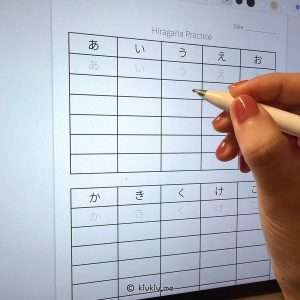
If you’re at the very beginning and still working on kana, I have a free printable hiragana and katakana practice PDF that you can use before moving into heavier JLPT-specific study.
The official JLPT website also provides sample questions and official practice materials for N5 through N1. These are particularly useful when you’re deciding which level to take because they let you see the format and approximate difficulty before spending money on a stack of textbooks.
📝 Related Posts in This Section →
Choosing Your JLPT Level and Starting Your Study Plan

You don’t need to take every JLPT level in order, but I do recommend studying from N5 upward. The vocabulary, grammar, and kanji build on what you learn at the lower levels, so you’ll need that foundation eventually even if you decide to skip the actual exams.
I studied through each level but waited until N1 to take the JLPT for the first time. You certainly don’t have to do the same—choose the exam level that makes sense for where you are now and gives you a realistic goal to work toward.
📖 Must-Read JLPT Study Tips & Strategies
- JLPT Study Planner with Hobonichi: Timeline and Layout Tips
- What to Do After Passing JLPT N1: How I Found New Motivation
- JLPT Test Results: How I Passed JLPT N1
- What to Expect on JLPT Exam Day: My Experience & Helpful Tips
- Improve JLPT Grammar Score: The Power of Reviewing Mistakes
- How to Improve JLPT Listening: Top Strategies & Tips
Looking for more ways to improve your JLPT study routine? Check out all my JLPT Study Tips for in-depth strategies, exam preparation advice, and motivation!
🌟 Popular Posts
- Best Summer Knitting Top Pattern: Top Sol by MochiKnits
- How I Set Up My Traveler’s Notebooks – Passport Size
- Best Hobonichi Weeks Layout Ideas for Your Needs
- Hobonichi Weeks Mega Review: Is It Worth The Hype?
Looking for fresh inspiration, practical tips, and creative ideas? Explore my most popular posts—the articles readers loved the most!
Explore More in Study







Latest Updates:







Featured Videos: