Gemstone Meaning: The Five Elements and Their Symbolism
 November 16, 2026
If you’ve ever had a Four Pillars (Saju) reading or browsed gemstone jewelry, you may have come across the Five Elements. Someone might say they need more Water, while another person chooses green stones to represent Wood. But what exactly are these elements, and why are gemstones associated with them in the first place?
When I started choosing stones for my own bracelets, color and appearance were my first considerations. Then I began reading about the traditional meanings people associate with different gemstones. Blue stones were often linked with calm, gold-toned stones with prosperity, and sometimes the same gemstone appeared under different elements depending on the source. That made me curious enough to look into the Five Elements themselves.
🔍 Continue Exploring These Series →
Table of Contents
- What Are the Five Elements?
- The Meaning and Symbolism of the Five Elements
- How the Five Elements Interact
- The Five Elements and Gemstone Meanings
- Gemstones Associated with Wood
- Gemstones Associated with Fire
- Gemstones Associated with Earth
- Gemstones Associated with Metal
- Gemstones Associated with Water
- Gemstones and Their Symbolism at a Glance
- Why People Keep Gemstones Close
- The Meaning of Carrying a Gemstone
- Using Your Saju Reading as Inspiration
- Choosing a Gemstone for What Matters to You
- Five Elements Bracelets Made with Natural Gemstones
- Finding a Gemstone Bracelet That Means Something to You
What Are the Five Elements?
The Five Elements, or Wu Xing (五行), are a traditional East Asian way of describing patterns of change in nature and the world around us. The five are Wood, Fire, Earth, Metal, and Water. They aren’t simply five physical materials, though. Each represents certain qualities, movements, and relationships.
Think of a tree stretching its branches upward, a fire giving off heat and light, or water changing shape as it flows. Earth provides the ground for things to grow, while Metal evokes strength, structure, and precision. These observations became a way to connect natural phenomena with ideas about the seasons, directions, colors, and much more.
One of the most important things about the Five Elements is that they don’t operate separately. They influence one another through cycles of change. This is why you’ll sometimes see Wu Xing translated as the Five Phases rather than the Five Elements. The Internet Encyclopedia of Philosophy’s discussion of Wu Xing explains this emphasis on processes and relationships.
The concept also appears in Saju, the Korean tradition of interpreting the Four Pillars of Destiny from a person’s birth year, month, day, and hour. I’ve been told in a Saju reading that my Water element was lacking, which made me wonder whether choosing Water-associated gemstones would be the answer. But traditional Four Pillars interpretations consider how the elements interact overall. Simply having fewer instances of one element doesn’t automatically mean that adding more is always preferable.
The Meaning and Symbolism of the Five Elements
Each element has its own characteristics. Rather than treating them as five fixed personality types, it helps to think of them as five different ways things move or change in nature. Their traditional colors and seasonal associations make the differences easier to picture.
Wood (木)
Wood represents a seed sprouting from the ground and a tree growing upward and outward.
- Key meanings: Growth, expansion, creativity, new beginnings
- Season: Spring
- Colors: Green and blue-green
Wood is often associated with the momentum of starting something new or gradually expanding your possibilities. It can be a meaningful symbol when you’re embarking on a new project, learning a skill, or hoping to grow in a particular area of life.
Fire (火)
Fire represents the warmth, light, and energy of a flame.
- Key meanings: Passion, expression, vitality, confidence
- Season: Summer
- Color: Red
Fire can symbolize the courage to take action or express yourself more openly. In traditional Five Elements thinking, though, more of a particular element isn’t necessarily better. The way it interacts with the other elements matters just as much.
Earth (土)
Earth represents the ground that supports and nourishes life.
- Key meanings: Stability, trust, balance, consistency
- Season: Late summer or the transition between seasons
- Colors: Yellow, beige, brown
Earth is often used as a symbol of feeling grounded and maintaining a steady rhythm. When everything seems to be happening at once, its imagery can be a reminder to find your footing and work through things one at a time.
Metal (金)
Metal represents the strength and precision of solid metal and the tools made from it.
- Key meanings: Decisiveness, order, clarity, principles
- Season: Autumn
- Colors: White and metallic tones
Metal is associated with sorting through complexity, setting priorities, and deciding what matters. The image of a finely made tool captures both strength and the ability to make clear distinctions.
Water (水)
Water represents the ability to flow around obstacles, adapt to different surroundings, and settle into stillness.
- Key meanings: Wisdom, flexibility, depth, reflection
- Season: Winter
- Color: Black (blue and navy are also common in modern gemstone designs)
Water combines movement with quiet. It can symbolize adjusting to change without losing your direction, or taking time to reflect before making a decision.
The Five Elements at a Glance
| Element | Main symbolism | Traditional colors | Season |
|---|---|---|---|
| Wood | Growth, beginnings, expansion | Blue-green, green | Spring |
| Fire | Passion, energy, expression | Red | Summer |
| Earth | Stability, balance, trust | Yellow | Late summer / seasonal transitions |
| Metal | Clarity, decisions, order | White | Autumn |
| Water | Wisdom, flexibility, reflection | Black | Winter |
This table summarizes commonly cited traditional associations. Modern color interpretations and individual traditions may vary.
How the Five Elements Interact
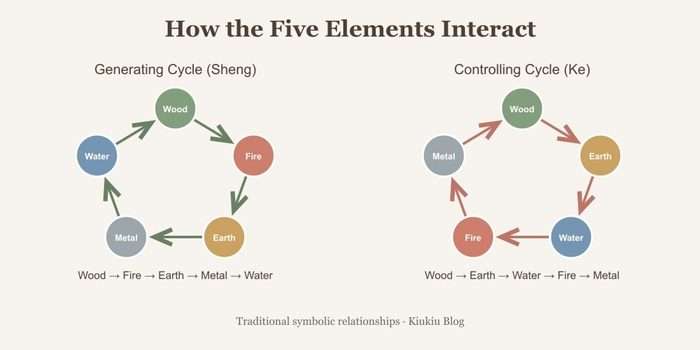
What makes the Five Elements interesting is the idea that they influence and regulate one another. Two familiar relationships are the generating cycle, called Sheng (相生), and the controlling cycle, called Ke (相剋). Their names can sound technical, but the underlying images are fairly easy to follow.
The Generating Cycle: Supporting the Next Element
The generating cycle describes how one element supports the next. Its traditional sequence is Wood → Fire → Earth → Metal → Water → Wood.
- Wood generates Fire: Wood fuels a flame.
- Fire generates Earth: Ash returns to the ground.
- Earth generates Metal: Metal ores are found within the earth.
- Metal generates Water: A traditional symbolic relationship in which Metal produces Water.
- Water generates Wood: Water helps trees and plants grow.
Some examples are intuitive, while others—especially Metal generating Water—are better understood as part of a traditional symbolic system than as literal scientific explanations. Together, they form a continuous cycle of support and transformation.
The Controlling Cycle: Keeping Things in Balance
The controlling cycle describes how one element restrains or regulates another. The sequence is Wood → Earth → Water → Fire → Metal → Wood.
Tree roots can break through soil; earth can contain water; water extinguishes fire; fire melts metal; and a metal axe cuts wood. These familiar images illustrate the controlling relationships.
Controlling doesn’t automatically mean harmful. Within the traditional framework, it can also represent the kind of restraint that keeps something from becoming excessive. So if you’re exploring Five Elements jewelry, it isn’t as simple as assuming that generating relationships are always good and controlling relationships are always bad.
The Five Elements and Gemstone Meanings
This is where gemstones come into the picture. For centuries, people have attached cultural and personal meanings to different stones. Today, gemstone jewelry sometimes brings those associations together with the colors and qualities of the Five Elements.
There is, however, no single universally accepted chart that assigns every gemstone to exactly one element. Some systems use color, others emphasize the stone’s appearance or symbolism, and modern crystal traditions may mix several approaches. The examples below are a starting point for exploring those connections, not a definitive classical classification.
Gemstones Associated with Wood
Wood represents growth and new beginnings, so green stones are a natural visual match. Their colors bring to mind fresh leaves and trees beginning to grow.
- Green Aventurine: Opportunity and growth
- Jade: Harmony and prosperity
- Malachite: Change and transformation, reflected in its vivid green patterns
These stones can be appealing when you want a piece of jewelry to represent a fresh start or continued growth. Even within the same green color family, each stone has its own appearance and associations.
Gemstones Associated with Fire
Fire brings to mind bright flames and lively movement. Red and orange gemstones are often chosen to express that energy.
- Garnet: Passion and devotion
- Carnelian: Vitality and courage
- Red Jasper: Strength and determination
These warmer colors make a noticeable accent, whether they’re worn on their own or combined with softer tones. They’re especially fitting if you’re drawn to the symbolism of confidence and taking action.
Gemstones Associated with Earth
The warmth and steadiness associated with Earth show up beautifully in yellow, brown, and gold-toned gemstones. Stones in this group are often linked symbolically with abundance, strength, or a grounded outlook.
- Citrine: Abundance and optimism
- Tiger’s Eye: Confidence and focus
- Smoky Quartz: Grounding and practical judgment
- Pyrite: Prosperity and abundance, reflected in its metallic golden shine
Pyrite is an interesting example because some interpretations associate it with Metal instead. Its placement depends on whether the emphasis is on its warm gold color, metallic character, or symbolic meaning.
Gemstones Associated with Metal
Metal often suggests clarity, precision, and a clean, polished appearance. White, silver-toned, and transparent stones work particularly well with this imagery.
- Clear Quartz: Clarity and a fresh perspective
- White Howlite: Calm and composure
- Moonstone: Change and intuition
- Golden Rutilated Quartz: Abundance and opportunity
Golden Rutilated Quartz is especially distinctive. Fine golden, needle-like inclusions run through the quartz, and no two beads look quite alike. Its associations can vary, so this is one example of a modern symbolic interpretation rather than a universal rule.
Gemstones Associated with Water
Think of deep water, and several shades might come to mind: black, clear blue, or rich navy. Black is Water’s traditional corresponding color, while modern jewelry frequently uses blue gemstones to suggest the element’s flowing qualities.
- Aquamarine: Calm and communication
- Lapis Lazuli: Wisdom and truth
- Sodalite: Clear thinking and communication
- Black Onyx: Protection and strength
- Obsidian: Protection and resilience
A pale blue aquamarine bead creates a completely different impression from a deep, dark stone. Both may suggest Water in a modern design, but choosing between them can simply come down to the colors you love.
Gemstones and Their Symbolism at a Glance
| Element | Gemstone examples | Common symbolic meanings |
|---|---|---|
| Wood | Green Aventurine, Jade, Malachite | Growth, harmony, new beginnings |
| Fire | Garnet, Carnelian, Red Jasper | Passion, vitality, courage |
| Earth | Citrine, Tiger’s Eye, Smoky Quartz | Abundance, focus, stability |
| Metal | Clear Quartz, Howlite, Moonstone | Clarity, composure, change |
| Water | Aquamarine, Lapis Lazuli, Sodalite | Calm, wisdom, communication |
The connections between gemstones and elements aren’t fixed. Pyrite, for example, may be placed differently depending on the qualities being emphasized. And meanings such as good fortune or protection are traditional or personal associations, not scientifically demonstrated effects.
Why People Keep Gemstones Close
People have long worn gemstones as ornaments or carried small stones because of the meanings they attach to them. For some, a stone represents protection; for others, it may be a symbol of luck, a fresh beginning, or a personal goal.
The Meaning of Carrying a Gemstone
Sometimes we choose a stone simply because we love its color or pattern. Other times, the meaning associated with it makes us want to keep it close. A gemstone can become a small reminder of something important—confidence, balance, calm, or an intention we’d like to carry into everyday life.
Keeping a stone nearby doesn’t guarantee any particular outcome. Still, the personal significance of an object can make it feel special, especially when it’s something you see or hold often.
Natural gemstones have another appealing quality: they’re all a little different. Even beads from the same type of stone can vary in tone, transparency, patterns, and inclusions. A piece of pyrite might have a striking metallic sheen, while rutilated quartz can reveal tiny golden lines inside. Those natural differences are part of what makes a stone feel like your own.
Using Your Saju Reading as Inspiration
Some people choose gemstones after hearing that a particular element is weak or missing in their Saju chart. They may look for colors or stones associated with that element as a symbolic way of inviting it into their lives.
For example, someone who wants to emphasize Wood might choose a green stone to represent growth, while someone drawn to Metal’s clarity might prefer white or transparent gemstones. Traditional Four Pillars interpretations look at the broader relationships among the elements, though, not simply which one appears least often. It’s best to think of these choices as an expression of personal meaning rather than a guaranteed way to change a Saju reading.
Choosing a Gemstone for What Matters to You
You can also choose a gemstone based on the qualities you want to keep in mind, even if you’ve never had a Saju reading.
- When you want to feel grounded: Smoky Quartz or Tiger’s Eye, inspired by Earth’s symbolism of stability
- When you’re drawn to calm and flexibility: Aquamarine or Sodalite, associated with Water
- When you’re starting something new: Green Aventurine or Jade, linked symbolically with Wood and growth
- When confidence is on your mind: Garnet or Carnelian, inspired by Fire’s energy
- When you want a symbol of abundance: Citrine or Pyrite, often associated with prosperity
These are ideas to explore, not prescriptions. The color, texture, and the feeling you get when you see a gemstone can be just as meaningful as its traditional symbolism.
Five Elements Bracelets Made with Natural Gemstones
As I learned more about the Five Elements and gemstone meanings, I started experimenting with making my own bracelets. These designs are the first collection to come out of that process.
Gemstone Highlights
I used several stones with different colors and symbolic associations:
- Pyrite: Prosperity and confidence
- Aquamarine: Calm and communication
- Lapis Lazuli: Wisdom and truth
- Clear Quartz: Clarity and a fresh perspective
- Golden Rutilated Quartz: Abundance and new opportunities
Wearing these stones isn’t a promise of a particular result. What I like is the idea of keeping those symbols close and having a small reminder of what I’m working toward.
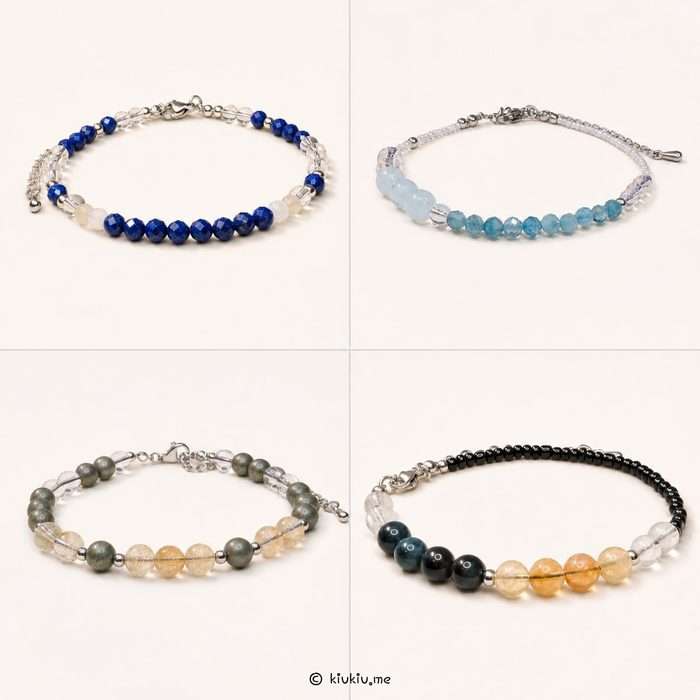
When selecting the beads, I was willing to spend a little more for stones that retained their natural colors and visible characteristics without excessive processing. Each bead has slightly different markings and tones. Some have fine lines or inclusions within them, and I actually find those differences to be one of the best things about natural gemstones.
Designed for Everyday Wear
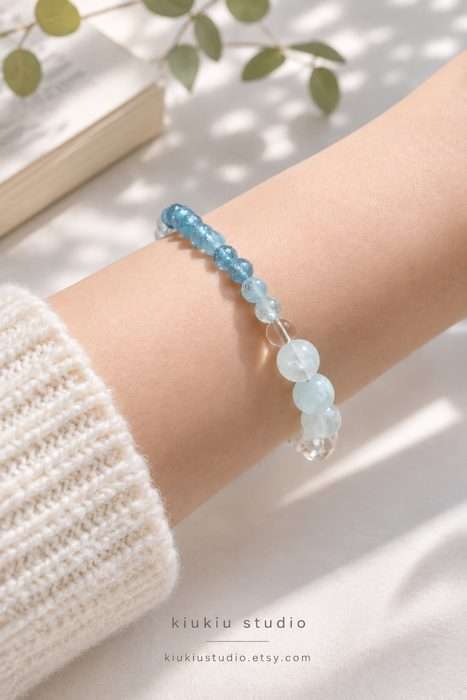
I spent a lot of time finding the right balance between color combinations and everyday wearability. If the idea is to keep meaningful gemstones close, I wanted the bracelets to work with ordinary outfits rather than feel like something reserved for special occasions.
I tried different bead sizes, color proportions, and arrangements until the designs felt balanced. The goal was to let the gemstones stand out without making the overall bracelet look too busy.
Finishing Details and Durability
The finishing method took some trial and error too. Stretch cord is convenient to slip on and off, but it may loosen or stretch with extended use. After testing different approaches, I chose wire and nylon cord with durability, shape retention, and wearability in mind.
This is only the first collection. I’d love to keep experimenting with other gemstones and combinations as I add more designs.
You can find these Five Elements-inspired bracelets in my Etsy shop.
📝 Related Posts in This Section →
Finding a Gemstone Bracelet That Means Something to You
When I first started shopping for gemstones, I mostly paid attention to which colors looked pretty. Learning about their symbolism changed the way I look at them a little. Aquamarine and Lapis Lazuli might both be blue, but they have such different personalities when you see them up close.
Some people may choose one of my bracelets for its colors, while others might be drawn to what the stones symbolize. Either way, I hope it’s something they enjoy reaching for and wearing for a long time. As for me, I’m already wondering which gemstones to try next. 😊
🛍 KIUKIU Store Picks & Updates
- Sourdough Journal for Home Bakers: Track Starter, Levain, and Bake in One Place
- Printable Knitting Journal: For Knitters Who Want to Keep Every Project
- Nail Art Planner: Printable Nail Design Template + Color Swatch Sheets
- Knitting Journal Notion Template: Your Complete Knitting Tracker
- Notion Board Game Tracker: Best Way to Organize Your Collection
Curious about my latest product releases? Browse all kiukiu store posts for announcements and updates.
💆♀️ Must-Try Mental Health & Mindfulness Practices
- Creative Hobbies for Stress Relief I Keep Coming Back To
- Morning Pages Prompts: 100-Day Journaling Challenge (Free Download)
- Start a Miracle Morning Routine: My Honest Journey
- Morning Routine for Productivity: How I Start and End My Day
- How to Reduce Social Media Time and Regain Control of Your Life
Want to reduce stress and gain mental clarity? Explore mindfulness practices, journaling techniques, and simple self-care habits: Browse All Mental Health Tips

Explore More in KIUKIU


Explore More in Life Plan



Featured Videos: