Printable Knitting Journal: For Knitters Who Want to Keep Every Project
 March 30, 2026
A printable knitting journal can be a lovely way to keep your projects together when scattered notes and half-remembered details no longer feel like enough. I still like using digital tools, and I do keep knitting records in Notion too, but I wanted something that felt a little different from a database. I wanted pages I could keep, flip through, print again, write on by hand, and save like a personal collection. There is something satisfying about seeing a project take shape on paper, especially after spending so much time choosing yarn, checking gauge, making small adjustments, and finishing the final details.
If you have ever searched for a knitting journal printable because your project notes ended up in random places, you are probably not alone. One sweater is in your phone notes, another is on a scrap of paper, a sock project is saved in a pattern app, and by the time you want to make something similar again, the useful details are hard to find. That was the gap I wanted this printable knitting journal to fill. Instead of a one-size-fits-all page that forces every project into the same layout, I wanted pages that feel more practical for real knitting projects, including garments, accessories, WIPs, and row tracking.
💡 Resources You Might Find Helpful →

Table of Contents
- What Is a Printable Knitting Journal?
- What’s Included
- A Closer Look at the Pages
- General knitting project page
- Garment project pages
- Accessory project pages
- WIP tracker and row tracker
- How to Use This Printable Knitting Planner
- Choose your preferred version
- Start with the page that fits your project
- Track details while you knit
- Add gauge and progress notes
- Finish the page after washing and blocking
- Who This Knitting Journal Is For
- How to Get the Template
- Why a Printable Knitting Journal Is Worth Keeping
What Is a Printable Knitting Journal?
A printable knitting journal is a set of pages designed to help you record the details of your knitting projects in a way that is organized, reusable, and easy to keep. Unlike a plain notebook, the pages already include sections for the information knitters usually want to remember later, such as yarn, needle size, gauge, measurements, modifications, progress notes, and finished project details.
What makes a printable knitting journal especially useful is flexibility. You can print only the pages you need, print the same page more than once, or use the files digitally in a PDF note-taking app with a stylus. That means you are not stuck with one fixed format. If you mostly knit sweaters, you can keep reusing garment pages. If you like quick hat and sock projects, you can focus on the accessory pages. If you work on several projects at once, the WIP tracker and row tracker can help you stay organized without adding more clutter.
For me, the biggest advantage of a printable knitting journal is that it feels more intentional than loose notes but more flexible than a bound notebook. It gives structure without feeling restrictive, which is exactly what I wanted.
What’s Included
This printable knitting journal includes a mix of project pages and tracking tools designed for different types of knitting projects.
You’ll Receive:
- 46 printable pages total
- 23 page layouts
- 26 PDF files
- 13 ivory files
- 13 white files
Page Types Included:
- 1 general knitting project page
- 10 garment project pages
- knit top
- high-neck sweater
- short-sleeve top
- cardigan
- vest
- 10 accessory project pages
- fingered gloves
- mittens
- socks
- hat
- gift project
- 1 WIP tracker
- 1 row tracker
Color Options:
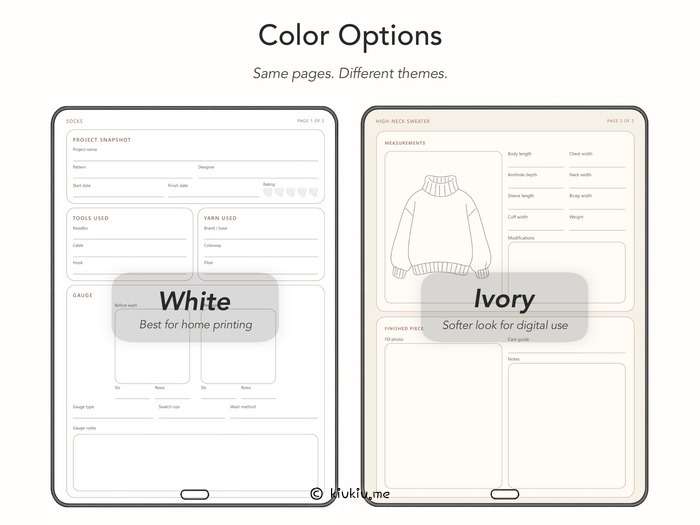
- Ivory version for a softer, warmer paper-like feel
- White version for a cleaner, print-friendly look
A Closer Look at the Pages
General knitting project page
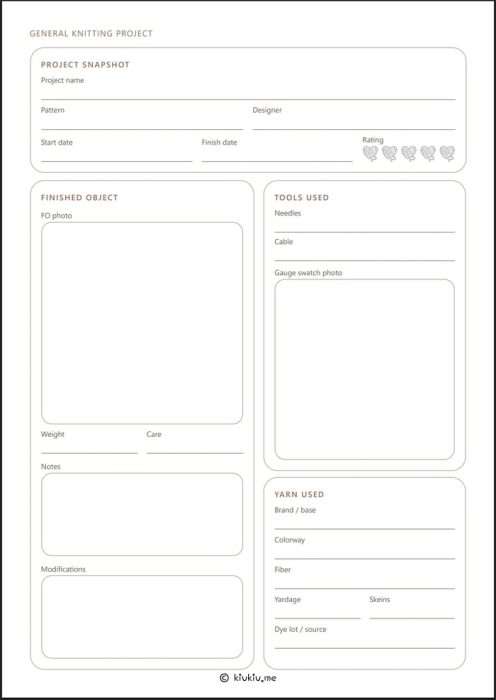
The general knitting project page is meant to be flexible. Not every project fits neatly into a garment or accessory category, and sometimes you just want a page that works for almost anything. This layout gives you a place to record the core information you usually want to keep: project details, yarn information, tools used, gauge, notes, and photos.
This kind of page is useful for projects that do not need highly specific measurement fields. It can also work well when you are still experimenting or when you want a simpler page before moving on to more specialized layouts. I wanted this page to feel open enough for different kinds of knitting while still giving enough structure to be useful later.
It is also a good option if you are working from your own idea instead of following a standard pattern. In that kind of project, a broad layout often makes more sense than a page with narrow measurement boxes.
Garment project pages
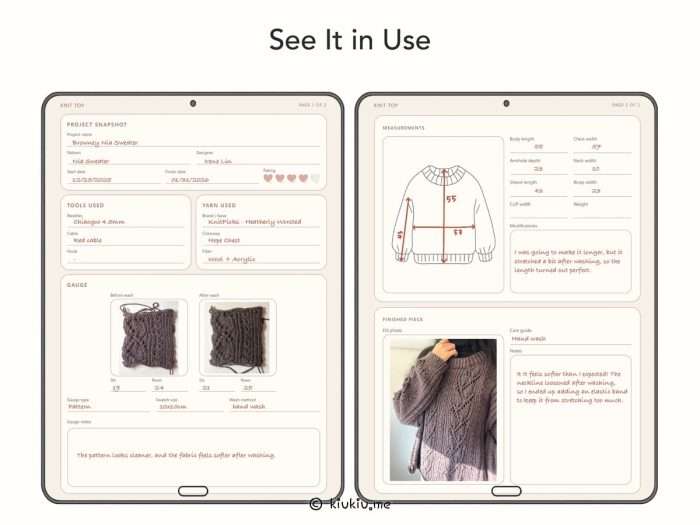
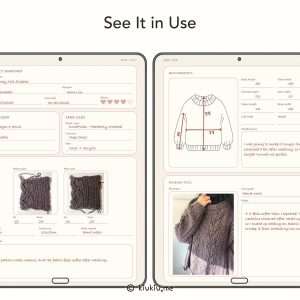
The garment project pages are designed for projects that need more planning, more measuring, and more detailed notes. While the overall structure stays consistent, the measurement fields are adjusted based on the type of garment so the pages feel more practical for real projects.
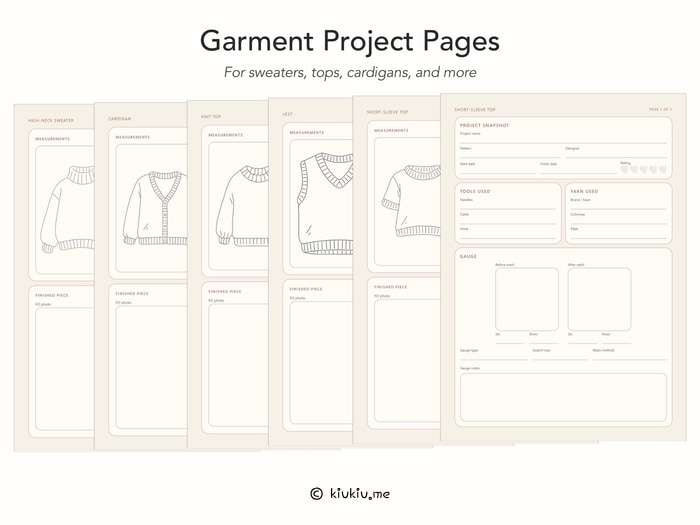
These pages include space for:
- Project snapshot
- Tools used
- Yarn used
- Gauge
- Measurements
- Modifications
- Finished piece details
Instead of forcing every garment into one generic layout, the pages are tailored to suit different project types more naturally. A cardigan, vest, high-neck sweater, and short-sleeve top may share some of the same core information, but the measurements worth tracking are not always the same. A cardigan does not need to be treated exactly like a vest, and a high-neck sweater may have details you would not want to track in the same way as a short-sleeve top.
This makes the garment pages especially useful if you want to keep better notes on fit, compare gauge before and after washing or blocking, or remember the modifications you made for future projects.
Accessory project pages
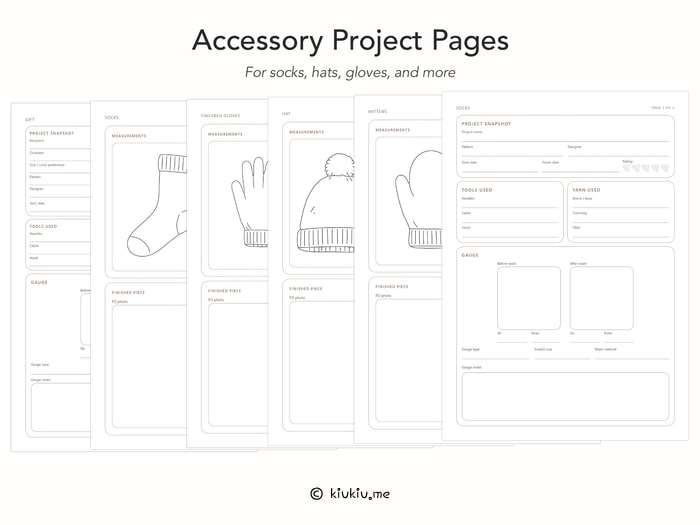
The accessory project pages are designed for smaller knitting projects like hats, socks, mittens, fingered gloves, and gift knits. Even though these projects may look simpler than garments, they still come with details worth keeping. Socks may need notes on sizing, heel construction, or yarn choice, while gloves and mittens often need measurements that would not make sense on a garment page.
The gift project page is especially useful when you want to remember who the project was for, the occasion, and any final details after gifting. You can even note the recipient’s feedback, which makes it a nice way to keep the story of the project along with the practical details. Just like the garment pages, these layouts follow a consistent style while adjusting the fields to better suit each type of project.
WIP tracker and row tracker
The WIP tracker and row tracker were included because project planning is only part of the story. Many knitters are juggling more than one project at a time, and even when we mean to stay focused, it is easy to lose track of where we left off.
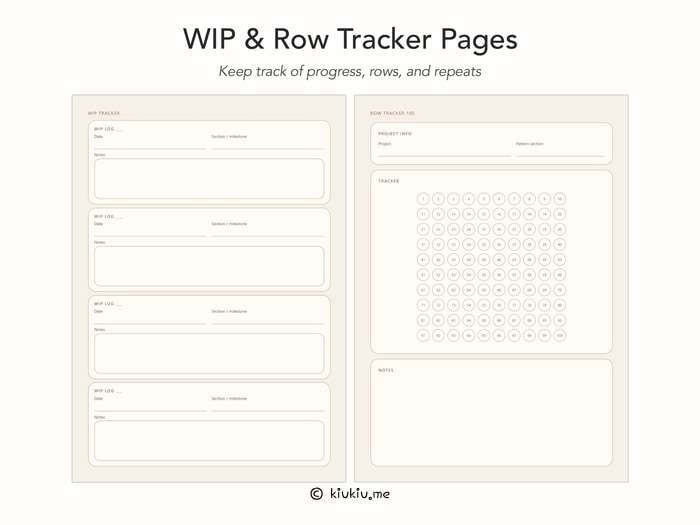
The WIP tracker gives you a simple place to record works in progress, progress notes, milestones, and reminders. This is helpful when a project is paused for a while or when you are moving between several projects depending on your mood, season, or available time. Instead of trying to remember where you stopped, you can just check your notes.
The row tracker is there for the more repetitive side of knitting. It helps with counting rows, repeats, and sections without needing random tally marks on scrap paper. This kind of page can be especially useful for pattern repeats, sleeve progress, body shaping, or any project where a clean visual tracker helps you stay consistent.
These pages are simple, but they are also the kind you may end up reprinting often. That is exactly why I wanted them included.
How to Use This Printable Knitting Planner
This printable knitting planner is designed to be flexible, so you can use it in a way that fits your own knitting routine. You can keep it simple or fill in a lot of detail as your project moves along.
Choose your preferred version
Start by choosing the version you want to use. If you plan to print the pages at home, the white version is usually the better option. If you are using a PDF note-taking app, both the white and ivory versions work well.
Start with the page that fits your project
When you begin a new project, open the PDF that best matches what you are making. Garment pages work well for sweaters, cardigans, vests, and tops, while accessory pages are better for projects like socks, hats, mittens, and gloves. If your project does not fit neatly into one category, you can use the general knitting project page.
Track details while you knit
As your project progresses, you can use the WIP tracker and row tracker to record notes, repeats, and important reminders. This is especially helpful when you are working on multiple projects or do not want to lose track of shaping, section changes, or pattern repeats.
Add gauge and progress notes
If you like documenting your gauge more closely, you can record both before- and after-wash details. You can also add photos if you want to compare how the fabric changes after washing or blocking.
Finish the page after washing and blocking
Once the project is finished, you can go back and complete the final details. You might write your measurements into the fields provided, or mark them directly on the project image if that feels more intuitive. This makes it easier to keep the finished result and the technical details together in one place.
Who This Knitting Journal Is For
This knitting journal is a good fit for knitters who like to keep more than the bare minimum. If you have ever wanted to remember what yarn you used, how the fabric changed after washing, what modifications you made, or why one project fit better than another, these pages were made with that kind of record-keeping in mind.
It is especially useful for knitters who work on garments and want to keep better measurement notes, but it is not limited to garment knitters. Accessory knitters, gift makers, and anyone who likes to track progress more clearly can get a lot out of it too.
I think it is also a nice option for knitters who enjoy the feeling of keeping a collection. That was part of the reason I made it in the first place. I already had digital records, but I wanted something that felt more personal and more tangible. I wanted pages that could hold not just technical details, but also the little notes that make a project feel like it is truly yours.
If that sounds familiar, a printable knitting journal can be a very satisfying format.
How to Get the Template
If you would like to try this printable knitting journal for yourself, you can find the template through the link below. The download includes all PDF files in both ivory and white versions.
Shop Printable Knitting Journal on My Store
Once downloaded, you can choose whether to print the pages at home or use them digitally in a PDF annotation app. You can also reprint or duplicate the pages you use most often, which makes the journal easy to adapt over time.
Why a Printable Knitting Journal Is Worth Keeping
A printable knitting journal is worth keeping because knitting projects often hold more information than we think. What seems obvious while a project is still on the needles can become surprisingly hard to remember later. Needle changes, gauge adjustments, fit tweaks, yarn substitutions, wash results, and pattern notes all start to blur together if they are not recorded somewhere dependable.
Having dedicated project pages makes that information easier to keep, but it also does something else. It helps your finished projects feel less temporary. Instead of ending as a photo in your camera roll and a vague memory of what you changed, the project gets its own place in your collection.
That is really the heart of this printable knitting journal. It is practical, yes, but it is also meant to make your knitting life feel a little more gathered together. Whether you use it for detailed garments, quick accessories, active WIPs, or future reference, the point is the same: to help you keep every project in a way that feels useful now and meaningful later.
🛍 KIUKIU Store Picks & Updates
- Nail Art Planner: Printable Nail Design Template + Color Swatch Sheets
- Knitting Journal Notion Template: Your Complete Knitting Tracker
- Notion Board Game Tracker: Best Way to Organize Your Collection
- Kids Activity Planner for Parents & Teachers (Notion Template)
- Korean Alphabet Worksheets: Printable Hangul Workbook
Curious about my latest product releases? Browse all kiukiu store posts for announcements and updates.
🧶 Must-Try Knitting & Crochet Projects
- Bottom-Up Cardigan Knitting FO: My First Fall Project
- Last Knitting Project This Summer: Lightweight Sweater Pattern
- My Favorite Things: Camisole No.4 — Simple Camisole Knitting FO
- Granny Square Cardigan FO: The Final Touches
- Modifying My Crochet Granny Square Cardigan for a Perfect Fit
- JHIA vs. TKGA: Which Knitting Certification Is Right for You?
- JHIA Knitting Certification: Is It Right for You?
- My Granny Square Cardigan Journey: Stitch by Stitch
Ready to start your next knitting project? Explore patterns, tutorials, and ideas for inspiration: Browse All Knitting & Crochet Projects
Explore More in Creativity
Explore More in KIUKIU


Featured Videos: