Best 3 Hobonichi Weeks Layout Ideas for Busy Weeks
 March 16, 2026
In 2026, life felt heavier than usual. Family responsibilities increased, unexpected situations popped up, and there were weeks when my mental energy felt thin. At the same time, there were still appointments to manage, household tasks to run, workouts to squeeze in, and study goals I didn’t want to abandon. I realized my usual Hobonichi Weeks layout ideas weren’t enough. I needed a layout that could carry me through busy weeks without overwhelming me further.
So I experimented. I adjusted columns. I moved sections around. I removed what felt too rigid and added what felt realistic. After trying multiple Hobonichi Weeks planner setups, I ended up with three layouts that genuinely helped me navigate different kinds of busy seasons. These are the ones I kept coming back to.
📚 Keep Reading in This Series →
- Free Mandala Chart Template for Your New Year Goals
- Hobonichi Weeks 2026 Setup: How I Set Up My Planner for 2026
- Best 3 Hobonichi Weeks Layout Ideas for Busy Weeks (reading now)
Table of Contents
- Layout #1 – The Must-Do First System
- How I Structured It
- The Key Rule That Changed Everything
- Why “Next Week – Don’t Forget” Helped So Much
- This Layout Is Ideal For
- Layout #2 – The Micro-Task Finisher
- How I Structured It
- Why This Layout Worked
- The Notes Section Became Unexpectedly Useful
- This Layout Is Ideal For
- Layout #3 – Productive but Mentally Gentle
- How I Structured It
- Why “Not Bad Moments” Worked Better Than Gratitude
- Combining Productivity and Stability
- What I Learned from Testing Hobonichi Weeks Layout Ideas
Layout #1 – The Must-Do First System
This layout is one I previously shared in my “Busy Mom” Hobonichi post, where I talked about planner options across different Hobonichi lines. In that post, I focused on finding the right planner for moms managing family schedules. Here, I want to zoom in specifically on how I use this layout inside the Hobonichi Weeks.
This setup came from a time when everything felt urgent.
There were multiple family events, child-related appointments, house-related tasks, and overlapping deadlines. I was also juggling larger home plans, and when too many moving parts exist at once, it becomes dangerously easy to miss due dates.
How I Structured It

Left Page (divided into 3 columns):
- Events / Appointments
- Family-Related
- Home Tasks (Chores)
Right Page:
- This Week – Must Do
- Meal Plan
- Next Week – Don’t Forget
- Notes
The Key Rule That Changed Everything
I stopped assigning every task to a specific day.
Instead, I wrote all of my must-do tasks in the “This Week – Must Do” section. Only items with fixed due dates went onto the left page under specific days.
This was a major shift.
Previously, I would distribute tasks across the week, neatly assigning them to Monday, Tuesday, Wednesday. It looked organized. But then something unexpected would happen. A family issue. A schedule change. An appointment that ran long. Suddenly, that day collapsed — and all the tasks attached to it collapsed with it.
It felt like failing over and over again.
By centralizing my weekly must-dos, I removed that pressure. Each day, I would open my Hobonichi Weeks and ask: What do I realistically have capacity for today? Then I would pull from the weekly list.
This method worked much better for busy weeks where unpredictability was high.
Why “Next Week – Don’t Forget” Helped So Much
When your week is full, planning two weeks ahead feels unrealistic. But not writing anything down means forgetting important things.
The “Next Week – Don’t Forget” section became a temporary holding space. I would quickly jot down reminders for the following week without fully planning them yet. It reduced mental clutter because I knew those items were captured somewhere safe.
This Layout Is Ideal For
- Overloaded family schedules
- Weeks with multiple due dates
- Times when you’re handling larger household or administrative tasks
- Anyone looking for a planner layout for busy moms that prioritizes flexibility
Among all the Hobonichi Weeks layout ideas I’ve tried, this one gave me the strongest sense of control during chaotic periods.
📝 Related Posts in This Section →
Layout #2 – The Micro-Task Finisher
After the bigger waves passed, my schedule changed. The major emergencies and heavy deadlines were mostly resolved. But suddenly I was surrounded by small, nagging tasks.
Reply to this email.
Order that item.
Schedule that follow-up.
Return that package.
Individually, they weren’t dramatic. Collectively, they were exhausting.
So I redesigned my layout.
How I Structured It
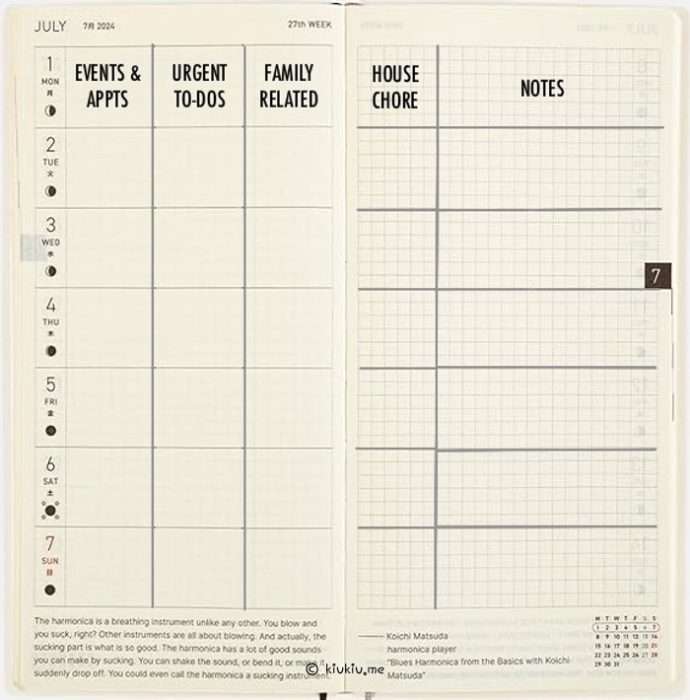
Left Page (3 sections):
- Events / Appointments
- Urgent To-Dos
- Family Related
Right Page:
- House Chores
- Notes (daily space)
This time, I needed clarity on small completions.
Why This Layout Worked
When tasks are small, they’re easier to skip. You tell yourself, “I’ll do it later.” But later never feels urgent enough.
By separating “Urgent To-Dos” clearly from general tasks, I visually elevated them. They weren’t floating in a long weekly list anymore. They had their own territory.
On the right page, I dedicated space to house chores instead of blending them into general tasks. It made them tangible. When housework is invisible in a planner, it’s also easy to ignore.
The Notes Section Became Unexpectedly Useful
The notes area wasn’t just for journaling.
Sometimes I wrote short reflections. Other times, I listed items I thought I needed to buy. Writing them down instead of immediately purchasing helped prevent impulse spending. If I still needed the item later, I could evaluate it more rationally.
This Layout Is Ideal For
- Weeks full of small but important tasks
- Post-crisis clean-up periods
- Productivity resets
- Anyone who struggles with skipping “minor” to-dos
It’s one of those Hobonichi planner layout inspiration styles that looks simple but makes a big behavioral difference.
Layout #3 – Productive but Mentally Gentle
There was another phase when I needed structure, but I also needed emotional breathing room.
I’ve written before about mental-focused Hobonichi layouts where the emphasis is fully on reflection and emotional awareness. In this version, however, I couldn’t go all-in on mental journaling because I still had responsibilities that required attention. I was also doing morning pages separately, which helped process deeper thoughts.
But I wanted something inside my weekly spread that felt softer.
How I Structured It
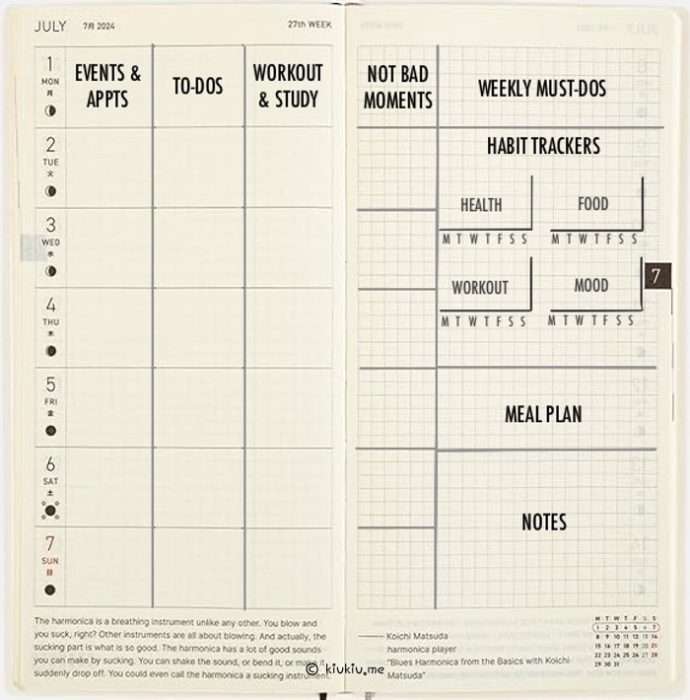
Left Page:
- Events / Appointments
- To-Dos
- Workout / Study
Right Page:
- Not Bad Moments
- Weekly Must-Dos
- Habit Trackers
- Meal Plan
Why “Not Bad Moments” Worked Better Than Gratitude
I’ve tried gratitude sections before. They’re powerful, but during emotionally heavy weeks, they can feel forced. When your day feels messy and someone says, “Find something amazing about today,” it can create resistance.
So I changed the standard format.
Instead of “Today’s Wins” or “Gratitude,” I wrote “Not Bad Moments.” The bar became lower and more human.
Maybe nothing incredible happened. But maybe:
- The coffee was warm.
- The workout didn’t feel terrible.
- A conversation went smoothly.
- The day ended without additional stress.
When framed as “not bad,” even small neutral experiences felt worth acknowledging. Over time, this shifted my perspective more naturally.
Combining Productivity and Stability
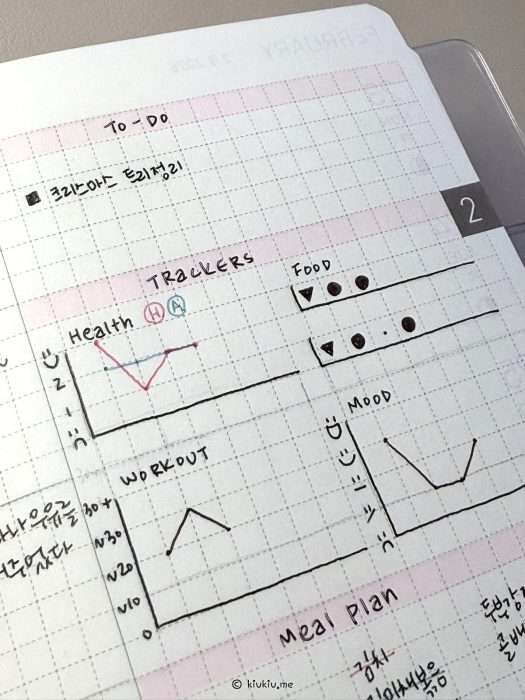
This layout still included:
- Weekly must-dos for clarity
- Habit trackers for consistency
- Meal planning for structure
It balanced output and wellbeing.
Among all the Hobonichi Weeks habit tracker ideas I’ve tried, this integrated version felt the most sustainable. It didn’t pretend life was perfect. It simply supported forward motion without emotional pressure.
📝 Related Posts in This Section →
What I Learned from Testing Hobonichi Weeks Layout Ideas
One thing became clear: the best layout depends on the season of your life.
Rigid planning works beautifully when life is stable. But when unpredictability increases, flexibility becomes essential.
Your planner shouldn’t become another source of stress. It should adapt with you.
If you’re in a chaotic season, centralize your must-dos.
If you’re in a cleanup phase, spotlight micro-tasks.
If your mental energy is fragile, soften the language of your reflection space.
There isn’t one perfect Hobonichi Weeks planner setup. There are only setups that match your current reality. Busy weeks are inevitable. But the way you structure your planner can make them feel either suffocating or manageable.
These three layouts carried me through different kinds of busy seasons, and I’ll likely keep adjusting as life shifts again. If you’re experimenting with Hobonichi Weeks layout ideas, don’t be afraid to redesign your spread mid-year. Sometimes the most helpful change is simply moving one box to a different place.
And sometimes, lowering the bar from “perfect” to “not bad” is exactly what makes everything workable again.
📚 Keep Reading in This Series →
- Free Mandala Chart Template for Your New Year Goals
- Hobonichi Weeks 2026 Setup: How I Set Up My Planner for 2026
- Best 3 Hobonichi Weeks Layout Ideas for Busy Weeks (reading now)
📝 Must-Try Journaling Ideas & Inspiration
- Hobonichi 2027 Lineup Preview: New Covers, Collaborations & Planners
- Sourdough Journal for Home Bakers: Track Starter, Levain, and Bake in One Place
- Kids Activity Planner for Parents: A Summer Schedule for Better Home Days
- Printable Knitting Journal: For Knitters Who Want to Keep Every Project
- Hobonichi Weeks vs Weeks Mega: Who Really Needs Mega?
Want to level up your journaling practice? Explore tips, prompts, and organization ideas: Browse All Journaling Tips
💆♀️ Must-Try Mental Health & Mindfulness Practices
- Creative Hobbies for Stress Relief I Keep Coming Back To
- Morning Pages Prompts: 100-Day Journaling Challenge (Free Download)
- Start a Miracle Morning Routine: My Honest Journey
- Morning Routine for Productivity: How I Start and End My Day
- How to Reduce Social Media Time and Regain Control of Your Life
Want to reduce stress and gain mental clarity? Explore mindfulness practices, journaling techniques, and simple self-care habits: Browse All Mental Health Tips
Explore More in Life Plan



Latest Updates:


Featured Videos: