How to Declutter a Closet When It Feels Too Overwhelming to Start
 February 16, 2026
I’ve written about decluttering before—general tips about a year and a half ago, and a more detailed post on reorganizing my skincare products last year. Both came from wanting less visual noise and fewer things to manage.
But one space I kept avoiding was my closet.
Life got busy. Clothes piled up, bags stayed tucked away, and dust settled in. I tried to declutter a few times, but each attempt ended with feeling overwhelmed and closing the door again. After COVID, my lifestyle shifted, and some bags I once used regularly sat untouched. A few leather ones didn’t get the care they needed and were too worn to keep, which made letting them go frustrating.
With a new year starting, I wanted to declutter my closet—but not in the everything-on-the-floor way. That felt unrealistic. Instead, I rethought how to declutter a closet when it feels too overwhelming to start by beginning with the smallest, easiest categories. No big promises—just one small area at a time. This post is the first step.
📝 Related Posts in This Section →
Table of Contents
- Where to Start When You Declutter a Closet
- Decluttering a Closet Step by Step: My Actual Process
- Step 1 — Keep vs. Let Go
- Step 2 — If You Keep It: Wash, Store, or Recycle
- Step 3 — If You Let It Go: Donate or Declutter Properly
- Step 4 — Update My Shopping List (Only If Needed)
- Start Small: Three Easy Categories to Declutter First
- Decluttering Towels
- Decluttering Underwear
- Decluttering Socks
- Cleaning Before Putting Everything Back
- A Small Start That Made Decluttering Feel Possible
Where to Start When You Declutter a Closet
One of the hardest parts of closet decluttering isn’t deciding what to keep or let go—it’s figuring out where to begin. When everything feels messy, every option feels equally wrong.
Starting in the wrong place often leads to quick burnout. Starting in the right place builds momentum.
Why Starting Big Often Fails
A lot of decluttering advice tells you to pull everything out at once. While that might work for some people, it can be overwhelming if you’re already short on time or energy. Once your entire closet is exposed, you’re committed—whether you’re ready or not.
That’s usually where things stall. Half-sorted piles sit around longer than planned, dust becomes another problem to deal with, and the pressure to “finish” turns decluttering into a chore instead of a reset.
When decluttering feels like a massive project, it’s easy to put it off indefinitely.
The Power of Small Wins
This time, I wanted a different experience. Instead of asking, “How do I finish my closet?” I asked, “What can I finish today?”
Small categories offer quick decisions and visible results. You can complete them in one session, clean the space properly, and put things back with intention. That sense of completion matters more than it sounds—it makes the next step feel less intimidating.
Approaching decluttering wardrobe step by step doesn’t mean going slowly forever. It means choosing a starting point that doesn’t drain you before you even begin.
Decluttering a Closet Step by Step: My Actual Process
Before touching any specific category, I needed a clear decision process. Not a rigid framework, but a set of repeatable steps I could follow without overthinking. This helped me stay practical and prevented decluttering from turning into another overwhelming project.
Step 1 — Keep vs. Let Go
The first decision is always binary.
I don’t think about storage, organization, or replacement yet—I only decide whether something stays in my life or not.
Keeping this step simple avoids endless “maybe” piles and makes it easier to move forward without second-guessing every item.
Step 2 — If You Keep It: Wash, Store, or Recycle
For items I keep, the next question is their condition.
Some things need to be washed before going back into storage. Others are clean and ready to be put away immediately. And some items are still usable but no longer make sense for their original purpose, which is where recycling comes in.
Separating these right away matters. Items that need washing go into a designated pile, and anything marked for recycling gets a clear next use instead of being set aside indefinitely.
Step 3 — If You Let It Go: Donate or Declutter Properly
Letting go doesn’t automatically mean donating.
I check whether the item is in a condition someone else could reasonably use, and whether it needs to be washed first. If donation makes sense, I handle that intentionally.
If an item isn’t suitable for donation, I declutter it properly instead of holding onto it “just in case.” I’ve learned that delaying this step is how clutter slowly creeps back in.
Step 4 — Update My Shopping List (Only If Needed)
Decluttering also highlights what’s missing or no longer sufficient.
After sorting through a category, I check whether letting things go created a functional gap. If something needs replacing, I add it to a dedicated shopping list instead of buying it right away.
This pause helps separate decluttering from impulsive shopping and keeps future purchases intentional. Ending the process this way makes decluttering feel complete—it clears space while setting clearer boundaries for what comes back in.
Start Small: Three Easy Categories to Declutter First
Once I had a clear process in place, the next decision was where to apply it. I didn’t want to start with anything emotionally loaded or visually overwhelming. The goal was simple: build momentum.
That’s why I chose categories that take up little space and are easy to evaluate. These are items most of us use regularly, which makes wear, excess, and gaps easier to spot.
For this first round of closet decluttering, I focused on three areas: towels, underwear, and socks. Each category has a clear function, a practical lifespan, and can usually be fully sorted in one session. Finishing them also creates immediate, visible order—exactly what you want when you’re just getting started.
Decluttering Towels
Towels were an easy place to start, but also more revealing than I expected. Because they’re used daily, wear builds up quietly over time. You don’t always notice how many you’re holding onto—or how many are no longer doing their job—until you actually pull them out and look at them one by one.
Before deciding what to keep or let go, I started by resetting my standards. Towels aren’t meant to last forever, and different types wear out at different speeds.
How Long Towels Actually Last
In general, towels last anywhere from two to five years, depending on how often they’re used, how they’re washed, and what they’re used for. But size and purpose matter more than I realized.
- Bath towels tend to wear out the fastest because they’re used frequently and washed often. For most households, 1 to 3 years is a realistic lifespan.
- Hand towels usually last a bit longer. They’re smaller, dry faster, and don’t go through quite as much friction in the wash.
- Face towels or washcloths need the most caution. Even if they look fine, they tend to lose softness and absorbency sooner.
I’m especially careful with anything that touches my face. My skin is fairly sensitive, so once a face towel starts feeling rough, stiff, or less absorbent, I don’t keep it in that role—even if it still looks “okay.”
Towels to Let Go
Some towels were easy decisions.
Anything with severe fraying, loose threads everywhere, or structural damage went straight into the let-go pile. At that point, they weren’t reliable or pleasant to use, and keeping them only added clutter.
I also let go of towels that had clearly reached the end of their functional life. When absorbency is gone, no amount of folding or reorganizing will fix that.
Towels to Recycle
Not every towel that leaves regular rotation needs to be thrown away.
Towels that still had a decent structure but were no longer ideal for daily use became recycling candidates. This included towels with reduced absorbency, visible discoloration from past laundry mistakes, or a texture that wasn’t something I wanted against my skin anymore.
I cut several of these into smaller pieces to use as cleaning cloths, especially for the car. Assigning them a new role immediately helped avoid the trap of “I’ll reuse this someday” piles that never actually get reused.
Some practical ways to repurpose old towels:
- Car cleaning cloths for dashboards, seats, and quick wipe-downs
- Household cleaning rags for kitchens, bathrooms, or floors
- Pet towels for muddy paws or post-bath drying
- Shoe-cleaning cloths for boots and sneakers
- Protective padding for delicate items during storage or moving
This kind of immediate reassignment made it easier to let go without guilt, while still getting value out of what I no longer needed in regular rotation.
What I Kept and What I’ll Replace
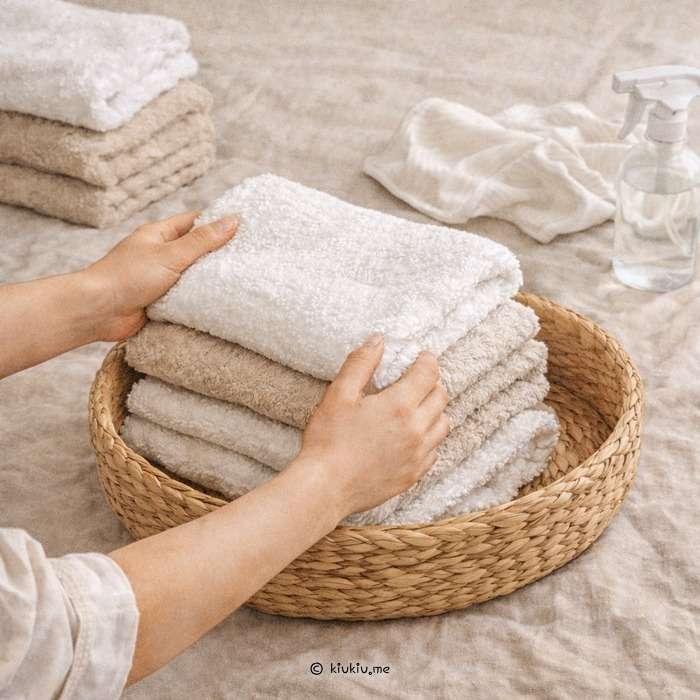
Once everything was sorted, what stayed felt intentional. The remaining towels were ones I actually enjoy using—soft enough, absorbent enough, and in quantities that make sense for regular rotation.
At the same time, decluttering made it clear that I’d reduced my towel count more than expected. Instead of seeing that as a problem, I treated it as information. It told me exactly what needed replacing, and what didn’t.
I added new towels to my shopping list rather than buying them right away. Decluttering helped clarify the gap, and delaying the purchase keeps that decision intentional instead of reactive.
Decluttering Underwear
Underwear is one of those categories that quietly accumulates over time. Because it’s stored out of sight, it’s easy to keep wearing the same few pieces while older ones sit untouched in the back of a drawer.
For me, decluttering underwear wasn’t about aesthetics or minimalism. It was about comfort, hygiene, and making sure everything I kept actually worked for daily life.
How Often Underwear Should Be Replaced
Most underwear has a shorter lifespan than we think. Even with proper washing, elasticity breaks down, fabric thins, and fit slowly changes.
As a general guideline:
- Everyday underwear typically lasts around 6 months to 1 year, depending on rotation and fabric quality.
- Bras can last longer, often 1 to 2 years, but only if they still provide proper support and shape.
- Items worn frequently or washed aggressively tend to wear out faster, even if they look fine at first glance.
Because underwear sits directly against the skin, I’m more conservative here than with other clothing categories. If something feels off, that’s usually enough information.
What to Let Go Immediately
Some decisions were straightforward. I let go of underwear that had lost its shape, felt stretched out, or irritated my skin.
Donation and recycling aren’t usually recommended for underwear, so once an item no longer serves its purpose, I don’t try to justify keeping it. Holding onto worn-out pieces only adds friction to daily routines.
Keeping Only What Still Works
What remained after decluttering felt noticeably lighter and more intentional.
Every piece left was something I actually reach for—comfortable, supportive, and appropriate for how I dress now. Removing older, unreliable items made it easier to see what I truly use, without rummaging or second-guessing.
Decluttering this category didn’t take long, but the impact was immediate. Opening a drawer and knowing that everything inside works is a small change that makes daily life smoother.
Decluttering Socks
Socks are easy to ignore because they’re small, but they wear out faster than most clothing. Friction, frequent washing, and daily use add up quickly, even if a pair still looks acceptable at first glance.
Decluttering socks was less about counting how many I owned and more about paying attention to condition and usability.
When Socks Are Past Their Prime
Socks tend to show wear in predictable ways.
Pilling, thinning fabric, stretched cuffs, or loss of elasticity were all signs that a pair had reached the end of its useful life.
Even if a sock technically still fits, I found it wasn’t worth keeping if it no longer stayed in place or felt uncomfortable during the day. Small irritations add up, especially with items you wear for hours at a time.
Letting Go of Worn-Out Pairs
Anything visibly worn, misshapen, or uncomfortable went straight into the discard pile. Socks don’t usually qualify for donation, so once they stopped functioning properly, I didn’t hesitate.
Making these decisions quickly helped keep the process moving and prevented overthinking.
A Simpler Way to Organize Socks
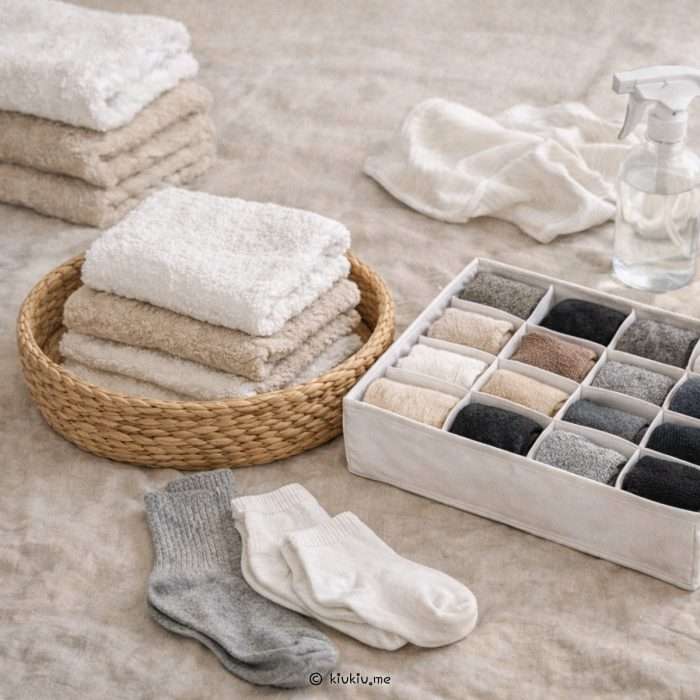
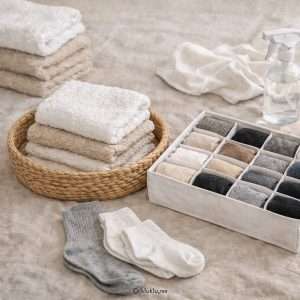
I used to roll my socks together, but that made it harder to see what I actually had. This time, I switched to a fabric container with divided sections.
I organized socks by season first, then by color, which made everything easier to see and grab. While sorting, I also found a few unopened pairs and put them into rotation instead of leaving them stored away.
Cleaning Before Putting Everything Back
Before putting anything back, I cleaned the space itself. It’s an easy step to skip, but it changes how the closet feels immediately.
Once the shelves and drawers were empty, the built-up dust was obvious. Wiping everything down made the space feel reset, and putting items back felt more intentional instead of rushed.
A Small Start That Made Decluttering Feel Possible
Starting with small categories changed how decluttering felt. Instead of being overwhelmed by the idea of a full closet reset, I was able to finish something—and that alone made the process feel manageable.
Decluttering towels, underwear, and socks clarified what I actually use and what needs attention next. In the next post, I’ll move on to accessories like gloves, scarves, and belts, continuing one small section at a time.
🧹Favorite Decluttering & Organization Hacks
- How to Organize Skincare Products for a Stress-Free Routine
- Skincare Decluttering: What Stayed and What Had to Go
- Brain Dump Technique: Simple Steps to Organize Thoughts
- Craft Organization Ideas: Simple Storage Solutions for Supplies
- How to Declutter Your Space: 6 Easy and Simple Decluttering Tips
Want a clutter-free and intentional lifestyle? Explore minimalism, organization tips, and decluttering hacks to reshape your space and priorities: Browse All Decluttering & Organization Tips
💆♀️ Must-Try Mental Health & Mindfulness Practices
- Morning Pages Prompts: 100-Day Journaling Challenge (Free Download)
- Start a Miracle Morning Routine: My Honest Journey
- Morning Routine for Productivity: How I Start and End My Day
- How to Reduce Social Media Time and Regain Control of Your Life
- Best Hobonichi Weeks Layout Ideas for Your Needs
Want to reduce stress and gain mental clarity? Explore mindfulness practices, journaling techniques, and simple self-care habits: Browse All Mental Health Tips
Explore More in Life Plan



Latest Updates:




Featured Videos: