Best Pens for Hobonichi That Don’t Smudge on Tomoe River Paper
 March 9, 2026
If you’ve ever searched for the best pens for Hobonichi, you already know this isn’t a simple question. Hobonichi planners use Tomoe River paper — thin, smooth, beautiful… and completely unforgiving when it comes to ink. Some pens glide like a dream but smear for minutes. Others dry fast but feel scratchy. And if you write small like I do — extreme fine tip, compact handwriting, tight grids — the margin for error is even smaller.
I prefer 0.28mm tips. My main writing is always black. Important events, bullet journal symbols, and habit trackers get color. Over the years, after testing countless combinations, I’ve narrowed down a pen setup that works consistently on Hobonichi and truly doesn’t smudge on Tomoe River paper. This post shares exactly what works, why it works, and how I use each pen in my daily layout.
🔍 Continue Exploring These Series →
Table of Contents
- What Makes a Pen the Best for Hobonichi?
- My Personal Hobonichi Pen Combo System
- Uni-ball Signo 0.28mm (UMR-82): The Smoothest Ultra-Fine Black
- Why It Works on Tomoe River Paper
- Dry Time and Smudge Test
- Compared to Pentel EnerGel
- Who This Pen Is For
- Uni Style Fit 0.28mm: Custom Color Without Smudging
- Zebra Mildliner: The Only Highlighter I Trust in Hobonichi
- Pens That Didn’t Work for Me
- My Hobonichi Pen Setup
- Questions People Also Ask About the Best Pens for Hobonichi
What Makes a Pen the Best for Hobonichi?
Before jumping into specific Hobonichi pen recommendations, it helps to understand why some pens struggle on Tomoe River paper.
Tomoe River paper is ultra-thin and very smooth. It resists ink absorption compared to standard planner paper. That smooth coating is what gives fountain pen lovers beautiful sheen and shading — but it also means wet ink sits on the surface longer. If you’re not careful, you’ll drag your hand across fresh writing and smear it.
So what makes the best pens for Hobonichi?
First, fast drying time. Pens that don’t smudge on Hobonichi typically have quick-set gel formulas or hybrid ballpoint ink. The thinner the line, the less ink deposited, which naturally reduces dry time.
Second, fine tip control. This is a personal preference, but it’s very important to me. Fine tip pens for Hobonichi planner layouts help maintain clarity within the 3.7mm grid. Anything thicker than 0.5mm can start to crowd small handwriting, especially when layering trackers, notes, and appointments in a single space.
Third, minimal show-through. Ghosting is unavoidable with Tomoe River paper, but bleed-through should never happen. The best pens for Tomoe River paper create crisp lines without soaking into the page.
With those principles in mind, here’s the combination that works for me.
My Personal Hobonichi Pen Combo System
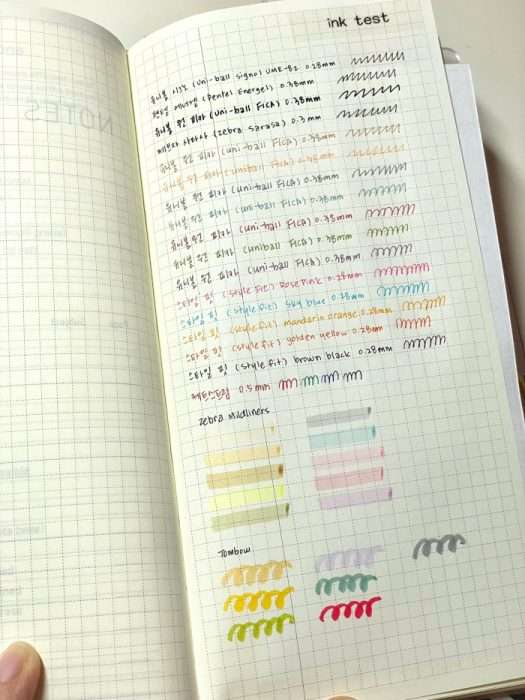
My system is simple and intentional.
- Black is for primary writing — schedules, journaling, task lists.
- Color is for structure — bullet journal symbols, important dates, habit trackers.
- Highlighting is minimal and controlled — mostly for section headers.
Because I write small, 0.28mm tips give me breathing room. They allow dense writing without visual clutter. If you also prefer compact layouts, ultra-fine tips will change your experience with Hobonichi.
Now let’s break down each pen.
Uni-ball Signo 0.28mm (UMR-82): The Smoothest Ultra-Fine Black
This is my main writing pen and one of the best pens for Hobonichi if you like extremely fine lines.
Why It Works on Tomoe River Paper
The Signo 0.28mm lays down a surprisingly consistent, controlled line. Even though it’s ultra-fine, it doesn’t feel scratchy. On Tomoe River paper, it glides smoothly without pooling ink at the start or end of strokes.
Because the tip is so fine, it deposits less ink, which dramatically reduces smudging.
Dry Time and Smudge Test
Does the Signo smudge on Hobonichi paper? With short drying time, it doesn’t smudge once settled. In my daily use, I’ve never experienced smearing after a few seconds. Even quick page flips rarely cause issues.
Compared to wetter gel pens, it sets noticeably faster. For people specifically searching for pens that don’t smudge on Tomoe River paper, this is a strong contender.

Compared to Pentel EnerGel
EnerGel is known for fast drying, but in ultra-fine sizes, I find the Signo smoother and more controlled on Hobonichi. EnerGel feels slightly more “wet” in comparison. If you prioritize line precision over boldness, Signo wins.
I’ve written a separate in-depth review of the Uni-ball Signo 0.28mm where I directly compare it to Pentel EnerGel — including close-up writing samples, dry-time testing on Tomoe River paper, and side-by-side performance results. If you’re deciding between the two, that breakdown goes much deeper into the differences.
Who This Pen Is For
This pen is ideal if:
- You write small
- You prefer crisp black ink
- You want one of the best pens for Hobonichi that prioritizes control over boldness
- You’re sensitive to smudging
📝 Related Posts in This Section →
Uni Style Fit 0.28mm: Custom Color Without Smudging
For color coding, this is my favorite system.
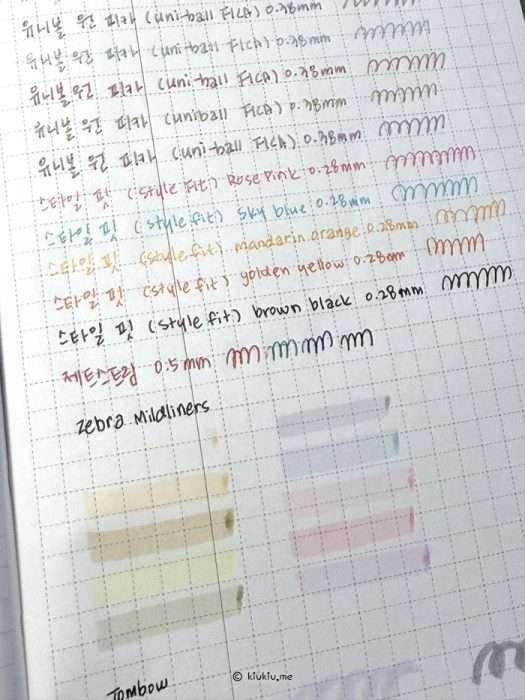
Build-Your-Own 5 Color System
Unlike standard multi pens that force basic red, blue, and green combinations, Style Fit lets you choose individual refills. I build my own five-color pen with shades that actually match my layout aesthetic.
The ability to customize color is a major advantage. You’re not stuck with default tones.
Performance on Hobonichi and Tomoe River Paper
In terms of performance, Style Fit 0.28mm behaves similarly to Signo. It doesn’t smear once dry and rarely feathers. The ink is vibrant but controlled.
If you’re looking for Hobonichi pen recommendations that balance beauty and function, this system is excellent.
Best Use in My Layout
I use Style Fit colors for:
- Bullet journal symbols
- Important dates
- Habit trackers
- Small headers
Because the line is so fine, colors remain subtle instead of overpowering the page.
Zebra Mildliner: The Only Highlighter I Trust in Hobonichi
Highlighters are risky on Tomoe River paper. Many bleed or leave heavy streak marks.
Why It Doesn’t Bleed Through
Zebra Mildliner has a softer, less saturated ink formula. Even when layering lightly, it doesn’t bleed through. Ghosting may increase slightly, but actual bleed-through is rare unless heavily layered.
How I Prevent Dark Edge Marks
One common issue with highlighters is the darker mark at the end of the stroke. I’ve found that if I lightly tap or press the end area immediately after applying Mildliner — while it’s still slightly damp — the darker patch softens.
This makes it perfect for section headers.
How I Use It
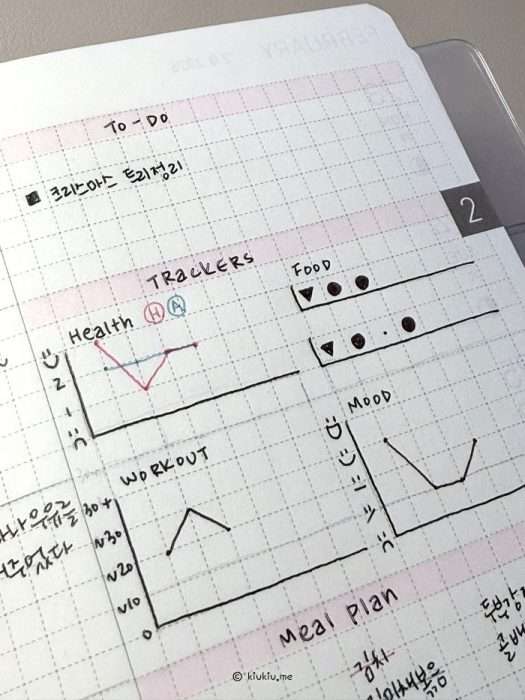
I mainly use Mildliner for:
- Section headers
- Weekly overview emphasis
- Subtle visual breaks
The color range is beautiful, and yes — collecting them can become endless.
Pens That Didn’t Work for Me
Not every pen marketed as fast-drying works well in Hobonichi.
Thicker 0.5mm gel pens tend to deposit too much ink, increasing dry time. Some smear easily on Tomoe River paper, especially if you flip pages quickly.
Certain rollerball pens feel smooth but remain wet longer than expected. If you’re specifically searching for pens that don’t smudge on Hobonichi, avoid overly wet ink formulas.
Ultra-bold tips also crowd the grid when writing small.
My Hobonichi Pen Setup
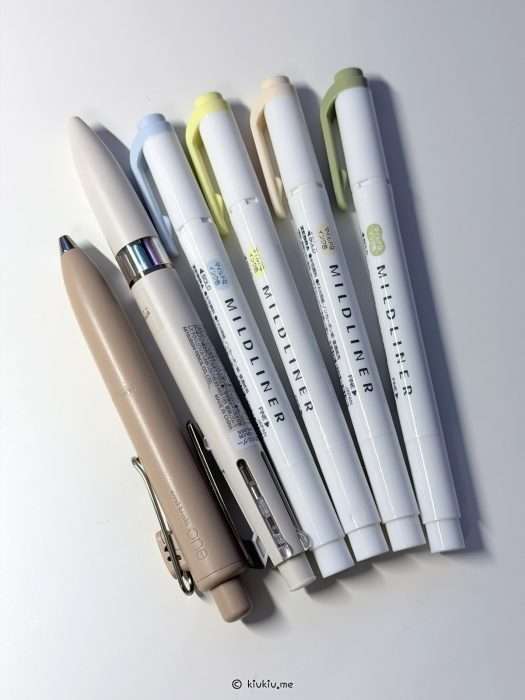
If you prefer small handwriting and minimal smudging, here’s the setup I recommend:
- Uni-ball Signo 0.28mm (black) for primary writing
- Uni Style Fit 0.28mm (3–5 custom colors) for structure and tracking
- Zebra Mildliner (1–2 muted tones) for headers
This combination balances precision, fast drying, and visual clarity — making it one of the most reliable systems for anyone searching for the best pens for Hobonichi.
In my habit tracker layouts, I use Style Fit colors to differentiate categories while keeping the base structure in black Signo. If you’re curious how I design those trackers and organize my daily spreads, I’ve shared a separate layout post walking through my setup in detail.
Questions People Also Ask About the Best Pens for Hobonichi
How much time do you need to let ink dry in a Hobonichi?
On Tomoe River paper, most fine-tip gel pens need around 5–15 seconds to fully settle. Ultra-fine tips like 0.28mm dry faster because they deposit less ink. Thicker 0.5mm or wetter pens can take noticeably longer. If you flip pages quickly, giving it a few extra seconds prevents smudging.
Why do some pens smear on Tomoe River paper?
Tomoe River paper is smooth and less absorbent, so ink sits on the surface before setting. Wet gel inks and rollerballs are more likely to smear if touched too soon. Fine-tip pens reduce ink volume and therefore reduce smudge risk.
Are gel pens or ballpoint pens better for Hobonichi?
Both can work, but fast-drying gel pens often give darker, cleaner lines. Hybrid ballpoints like Jetstream dry quickly but may feel slightly less smooth. If your priority is bold black with minimal smudge, gel pens are usually preferred.
Is 0.28mm too thin for Hobonichi?
Not at all — especially if you write small. The Hobonichi grid is compact, and ultra-fine tips help maintain clarity in dense layouts. If you prefer larger handwriting, 0.3–0.4mm may feel more comfortable.
Does Tomoe River paper cause more ghosting with certain pens?
Ghosting depends more on ink saturation than tip size. Highly saturated or layered ink (especially highlighters) can increase show-through. However, most fine-tip pens that don’t smudge on Hobonichi will not bleed — ghosting is normal and expected with thin paper.
Finding the best pens for Hobonichi is ultimately about understanding how ink interacts with Tomoe River paper and how you personally write. If you write small and prioritize clean, controlled layouts, a fine-tip system like this can completely transform your experience.
🖊️ Popular Stationery Reviews
- Hobonichi Weeks vs Weeks Mega: Who Really Needs Mega?
- Uni-ball One P Refill Compatibility: The Best Gel Pen Setup with Signo
- Best 2026 Planners: Top Picks for Every Planning Style
- Hobonichi Weeks 2026 Review: Purchase & First Look
- Hobonichi Weeks vs Traveler’s Notebook: Which One Fits You?
Looking for the best stationery to enhance your journaling experience? Check out all my Stationery Reviews for detailed insights, product recommendations, and tips to help you choose the perfect tools for your creative projects!
✂️ Must-Try Stationery DIY Projects
- Hobonichi Weeks 2026 Setup: How I Set Up My Planner for 2026
- Time Tracker for Hobonichi Weeks & A6 (Free Download)
- How I Set Up My Traveler’s Notebooks – Passport Size
- Best Hole Punch for Ring Binders: What Worked & What Didn’t
- DIY Washi Tape Binder with Travelers Notebook
Looking for creative ways to personalize your stationery? Dive into all my Stationery DIY projects for step-by-step tutorials, unique ideas, and inspiration to elevate your journaling and crafting experience!
Explore More in Creativity


Latest Updates:

Featured Videos: